

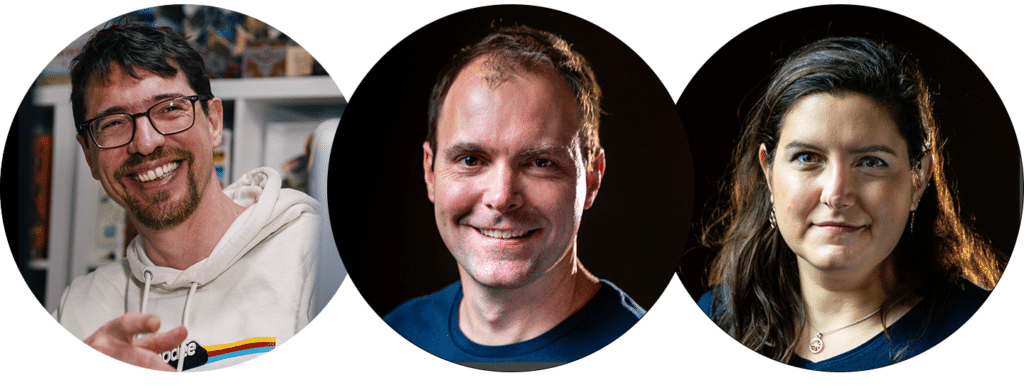
Figuring out the visual language of a game isn’t just about the illustrations, it’s also about the graphic design. Graphic design is a language of its own and can help communicate theme as well as guide players for usability as they navigate the gameplay. Once again our epic team of Gilles-Romain Fonteny, Art Director from Space Cowboys, Jason Taylor, our Visual Restoration Wizard, and Lindsay Daviau, our Production Superhero, banded together to give this game the polish and cohesive visual language it needs.
What do you hope players will feel when they see the game all set up?
Jason: I think people are going to be impressed by the amount of moments in the game that are big moments and actually feel big. All of these battles are huge, literally and figuratively. But at the same time you do have these little moments happening with the action cards and decisions to make along the way. A giant battle is going on but one turn you may just focus in on the Witch-king and that narrative moment. It’s a ton of fun.
Lindsay: I hope when people see the game set up they feel the epicness of the books splayed out on the table!
What are your favorite moments from The Lord of the Rings?
Lindsay: My favorite moment is when Éowyn is on the battlefield and says “No living man am I.” I get so excited when you see someone that is considered an underdog kind of stepping up and being a hero. I love that.
Jason: I’m a sucker for anything Samwise. I think he’s honestly the most heroic character in all of The Lord of the Rings. The moment when Frodo can’t go any further and Samwise offers to carry him. That is amazing and heartbreaking. It’s friendship and heroism all together and is one of the most heroic moments in all of The Lord of the Rings to me.
How does the gameplay influence the graphic production?
Lindsay: One of the things that I focus on when working on a game is where players need to look for information when they’re playing. I want to make sure the information you need is accessible and that the flavor elements that can bring you into the story are very present but also in the background so it adds to the story but doesn’t impede what you need to know for actually playing the game. You look at size, color, and shape to figure out what will draw the player’s eye. This is a really fine balance to strike as the art and graphic design develop.
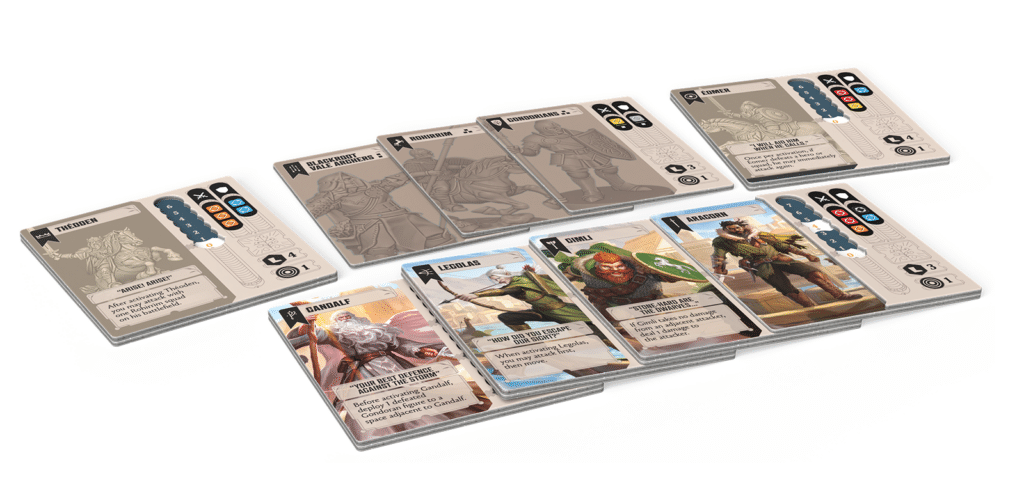
Art and components in progress
How do you find the compromise between art and gameplay and graphics?
Lindsay: As a production artist, what I see in my main job is turning the art director’s vision into reality. Jason and Gilles came up with this beautiful look for this game. I get to take those ideas and turn them into real production files that the manufacturer can print and turn into a real product that players can put on their table.
One of the most exciting times working on a game is when you see the first prototype with the real art. Whatever you think it’s going to look like on the screen, it doesn’t translate the same in reality. It’s always a surprise. It’s a really fun and important part of the process to see things physically and see what works the way you hoped it would and expected it would, and what doesn’t. Then you get to figure it out from there and solve the puzzle to make it an even better game in real life on the table. How will players interact? What information do they need to know to play? Where will their eyes go naturally with the art? That’s a big part of my job.
How do you approach creating a cohesive look across an entire game?
Gilles: Any graphic project, any game, you try to have a coherence. With this game, for example, we’re going to have more angular lines for all of the frames on Sauron’s side. Whereas with the Free People, it’s going to be more curves and softer lines. So we have these little elements of graphic cohesion that are quite similar. It’s still a frame with embellishments, but with small touches that will make it lean more towards the side of evil or the side of good. We have the same element in terms of graphic proportions, but we worked differently to adapt it to one side or the other.
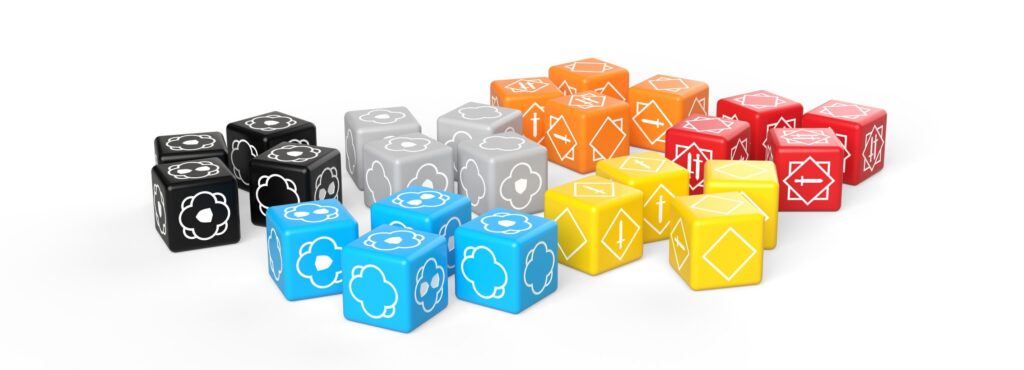
So overall it’s pure and hard graphic work to reuse elements throughout the game to have a graphic coherence. There is a link between the dice action and the iconography of the dice. We want it to feel natural and players don’t have to ask themselves a question about what this icon relates to. They stay in the narrative of the game and the graphics keep them in Tolkien’s universe.
How do you use color, contrast, or composition to guide players?
Lindsay: So one of my secrets of being a production artist for board games, is that your eyes are naturally attracted to areas of high contrast. So if you have a bunch of black and white elements together that’s high contrast and your eyes will naturally go there. So if there’s something that is important for you to pay attention to, we’ll bring more contrast to it. And if there’s something that is more subtle that’s okay to be in the background, you make the values of those colors more similar, and it’ll blend together instead. This is a great way to lead the eye and communicate information through visual direction for a player.
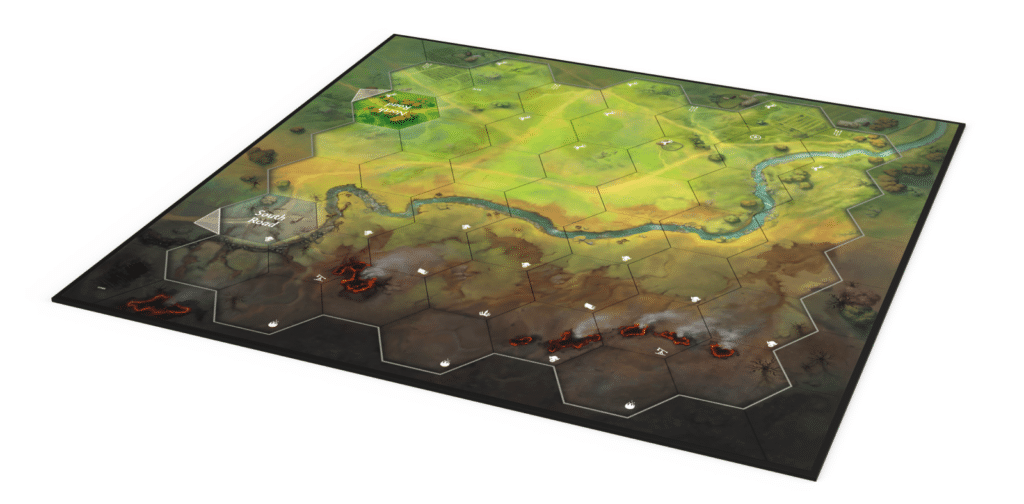
Gilles: We will see on the plateaus that The Pelennor Fields in the north are in flower, it is spring. It is a beautiful world but it will gradually deteriorate on the board from one side to the other side, to burned fields and land that is devastated by the war. It’s a little nightmarish and that visual will play on the narrative that they are experiencing as their troops move forward and advance to the other side. I think that’s really the core importance of the art and illustration in the game. It’s about offering a well-known experience but bringing it to something new.
Were there any moments where art changed gameplay or vice versa?
Lindsay: There’s definitely a back and forth between the graphic designers and the game designers. The game design will come up with this giant epic gameplay experience but then the art team needs to make it real and turn it into a product. So how do we make all these big ideas into something we can produce? There are a lot of questions and ideations to get to the final game. Definitely a little push and pull there.
Gilles: As soon as the gameplay evolves, we redesign. We redesign the character sheets, the action cards, that kind of thing. We try to make it as simple as possible for the player. Sometimes art will take up too much space, so we reduce that so it’s more effective. Sometimes we will want the narrative to take over at certain moments, so we’re going to increase the place of the illustrations because we think that it offers strong moments to players to have these visuals present.
You want a gaming experience that isn’t just mechanical. It’s still The Lord of the Rings universe and it speaks a lot to the hearts of people, the hearts of fans. So we need to bring them more than a good mechanical game, we need to bring them a whole universe on the table. I think the illustrations we did are the heart of the project. I think that any fan who discovers a new The Lord of the Rings game wants a new experience. They want to be projected into this universe again but in a new way to feel these emotions again. They know the books by heart and they want to feel like they’re in the middle of this story. They want to live it, to be the heroes for the duration of the game. But I think they also want to rediscover, to be surprised. So the illustrations and graphic design are the heart of the project, but the asymmetrical design really brings something special. They’re very linked.
What's one change from the original that fans will notice immediately?
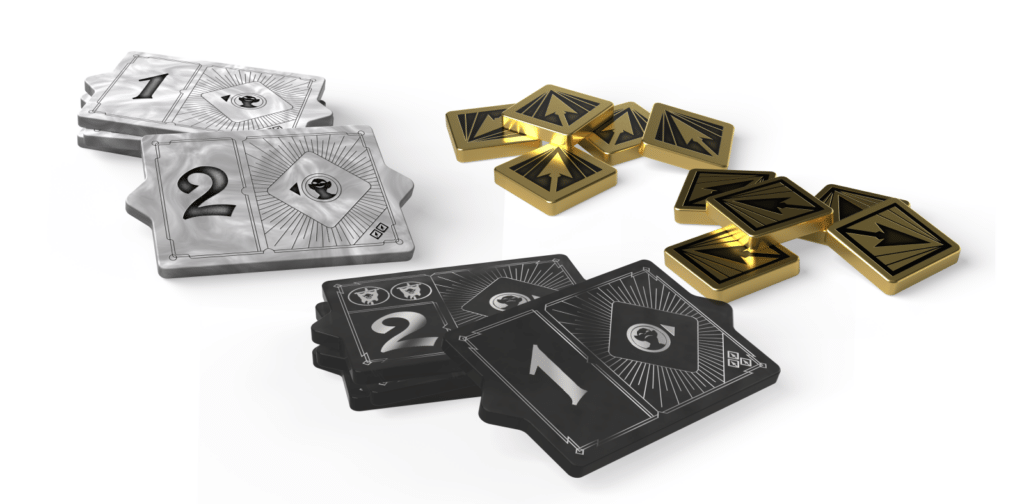
Jason: I think the introduction of the Resolve and Momentum tokens are a really cool new item from the game designers. If you’re familiar with the older game, the action cards had two choices. But now during the game these tokens will give more ownership and weight to your decisions. It’s a great addition to the game and makes it more replayable.
This is a big game with a lot of pieces. How do you guide players to understand the components?
Lindsay: With the graphics for a board game we’ll do a lot of really subtle things to help connect related components. To help players know which dice to roll for a certain action, for example, with the graphics. There are usually visual cues with shapes, colors, lines, etc. There are connected threads visually for types of cards or pieces so you know what it is at a glance. We try to help the gameplay come to life with the graphic design.
Art and Components in progress. TM & © MEE
—
Thanks everyone for giving us a look at how graphic design brings the visuals together! Learn more about The Lord of the Rings™: The King's Gambit and back the campaign here!